

Basel Convention Regional Centres
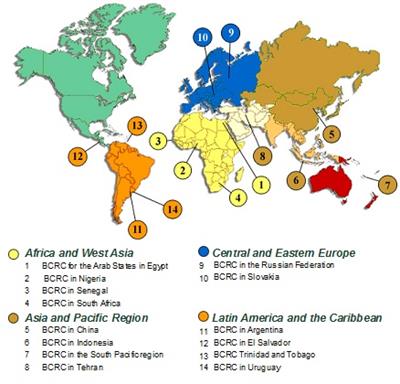
The Basel Convention is the first global environmental agreement that has established Regional or sub-regional Centres for training and technology transfers regarding the management of hazardous wastes and other wastes and the minimization of their generation to cater to the specific needs of different regions and subregions (article 14). Fourteen such centres have been established. The Centres are well positioned to promote South-South cooperation, enhance local capacities and support the implementation of the Basel Convention.
The BCRCs are located in Argentina, China, Egypt, El Salvador, Indonesia, Islamic Republic of Iran, Nigeria, Russian Federation, Senegal, Slovak Republic, the South Pacific Regional Environment Programme (SPREP), South Africa, Trinidad and Tobago and Uruguay.
The BCRCs, were established through a framework agreement between the host government /institution and the Secretariat on behalf of the Conference of the Parties; COPs. The framework agreements of each of the centres guide them on their roles and responsibilities. The BCRCs have been given clear mandates on their core functions and responsibilities. A methodology for the evaluation of their performances was also developed, based on specific criteria. These mandates and guidance aim at ensuring efficient regional delivery of technical assistance in a highly professional manner.
The fifth Conference of the Parties of the Basel Convention placed the Regional Centres high on the agenda for the Convention's next decade, seeing them as a logical and efficient means for raising awareness about the Convention's obligations and assisting in their implementation. Towards those ends, a central task over the coming years will be to design a more permanent structure for Regional Centres, based on a comprehensive strategy able to ensure their long-term sustainability and to promote and facilitate the implementation of the Basel Convention and associated decisions of the Parties to the Convention at regional and national levels.
The Basel Convention Regional Centres are operating as a regional delivery mechanism for the implementation of the Basel Convention with the perspective of establishing an integrative approach towards the implementation of the other chemicals conventions such as the Stockholm Convention on Persistent Organic Pollutants (POPs) and the Rotterdam Convention on Prior Informed Consent (PIC).
The core functions of the Basel Convention Regional Centres are as follows:
(1) Developing and conducting training programmes, workshops, seminars and associated projects in the field of the environmentally sound management of hazardous wastes, transfer of environmentally sound technology and minimization of the generation of hazardous wastes, with specific emphasis on training of trainers and the promotion of ratification and implementation of the Convention and its instruments;
(2) Identifying, developing and strengthening mechanisms for the transfer of technology in the field of environmentally sound management of hazardous wastes or their minimization in the region;
(3) Gathering, assessing and disseminating information in the field of hazardous wastes and other wastes to Parties of the region and to the secretariat;
(4) Collecting information on new or proven environmentally sound technologies and know-how relating to environmentally sound management and minimization of the generation of hazardous wastes and other wastes and disseminating these to Parties of the region at their request;
(5) Establishing and maintaining regular exchange of information relevant to the provisions of the Basel Convention, and networking at the national and regional levels;
(6) Organizing meetings, symposiums and missions in the field, useful for carrying out these objectives in the region;
(7) Providing assistance and advice to the Parties and non-parties of the region at their request, on matters relevant to the environmentally sound management or minimization of hazardous wastes, the implementation of the provisions of the Basel Convention and other related matters;
(8) Promoting public awareness;
(9) Encouraging the best approaches, practices and methodologies for environmentally sound management and minimization of the generation of hazardous wastes and other wastes, for example, through case studies and pilot projects;
(10) Cooperating with the United Nations and its bodies, in particular the United Nations Environment Programme and the specialized agencies, and with other relevant intergovernmental organizations, industry and non-governmental organizations, and, where appropriate, with any other institution, in order to coordinate activities and develop and implement joint projects related to the provisions of the Basel Convention and develop synergies where appropriate with other multilateral environmental agreements;
(11) Developing, within the general financial strategy approved by the Parties, the Centres' own strategy for financial sustainability;
(12) Cooperating in mobilization of human, financial and material means in order to meet the urgent needs at the request of the Party(ies) of the region faced with incidents or accidents which cannot be solved with the means of the individual Party(ies) concerned;
(13) Performing any other functions assigned to it by the decisions of the Conference of the Parties of the Basel Convention or by Parties of the region consistent with such decisions.